
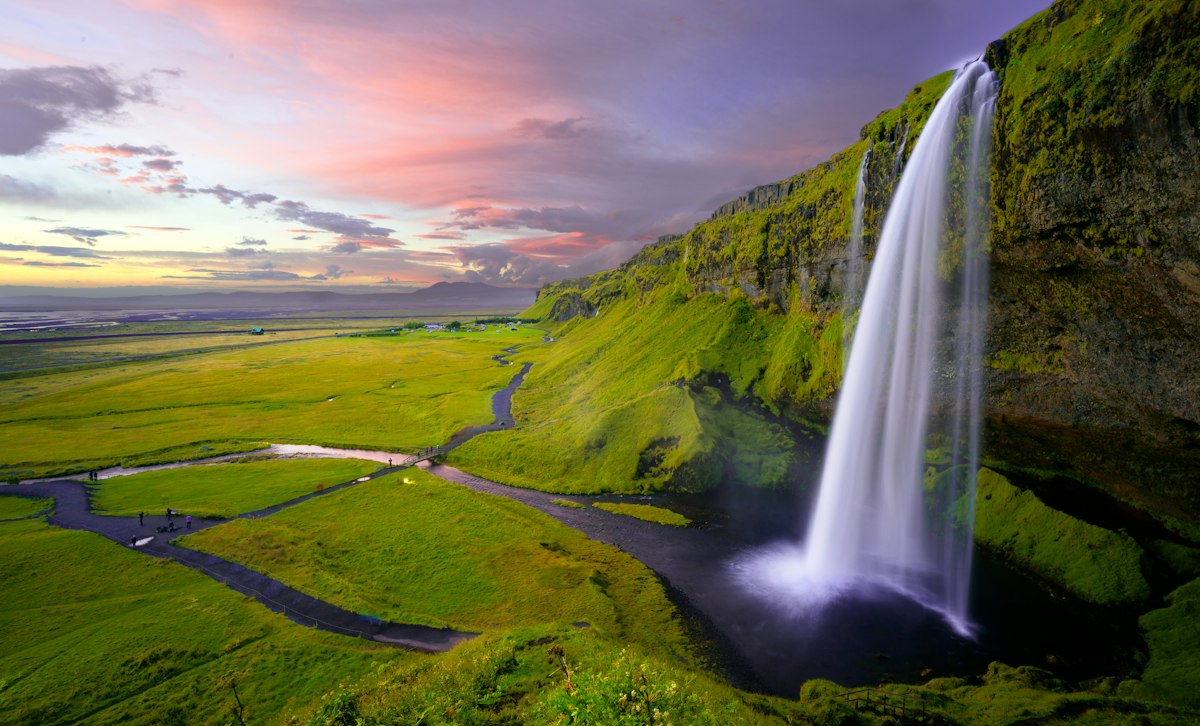
Iceland is one of the few places where you can hike across a lava field in the morning, walk behind a waterfall at lunch, and end the day on a glacier. The landscape is genuinely alien — black volcanic rock, electric green moss, steam rising from the ground, rivers that turn turquoise where glacial water meets sunlight. The hiking infrastructure is well-developed and most trails require no technical experience.
Landmannalaugar: The Highlands Rainbow
”
Landmannalaugar is the starting point of the Laugavegur Trail and one of Iceland’s most striking landscapes in its own right. The mountains here are rhyolite — a volcanic rock that oxidises into shades of yellow, red, green, and purple. The result is a colour palette that looks more like a painting than a real place. Day hikes from the Landmannalaugar base camp reach the top of Bláhnjúkur (the Blue Peak) and cross the Laugahraun lava field that formed in a 1477 eruption.
The Laugavegur Trail

”
The Laugavegur runs 55 kilometres from Landmannalaugar to Þórsmörk over four days. It passes obsidian lava fields, geothermal hot springs, a desert of black sand, and glaciers. The trail is well-marked and has mountain huts (huts must be booked months in advance) or camping at each stage. It is Iceland’s most famous multi-day trek and fills up quickly for July and August — book by March at the latest for summer dates.
Fimmvörðuháls: Waterfalls and Lava

”
Fimmvörðuháls is a one-day pass crossing between Skógafoss waterfall on the south coast and Þórsmörk. The trail passes twenty-six waterfalls in the first section, then climbs through the lava field created by the 2010 Eyjafjallajökull eruption. The contrast between the green waterfall canyon below and the raw black lava above is one of the most dramatic single-day hiking experiences in Europe. The crossing is 25 kilometres and takes eight to twelve hours.
Practical Information

”
The hiking season in Iceland’s highlands runs from late June to early September — mountain roads open late and close early, and many huts are only staffed during this window. Weather changes fast at altitude. The key gear items are waterproof layers, gaiters for river crossings, and trekking poles. Highland buses connect trailheads during summer, making car-free hiking logistics straightforward.
Route, budget and verification notes
Last editorial review: 1 August 2026. Recheck time-sensitive details shortly before travel.
Build the route
- Landmannalaugar: The Highlands Rainbow
- The Laugavegur Trail
- Fimmvörðuháls: Waterfalls and Lava
- Practical Information
Use these sections as planning anchors rather than a fixed schedule. Confirm door-to-door transfer times, opening days and reservation requirements, then add recovery time after long journeys.
Budget before booking
Price the trip in four separate groups: accommodation, transport, food and paid activities. Add local transfers, baggage fees, taxes, insurance and a contingency amount. Exact prices vary by season and booking date, so this guide does not invent a single daily figure that may already be outdated.
Sources to verify
- Visit Iceland for official or primary travel information.
- IATA Travel Centre for passport, visa and health-document checks.
