
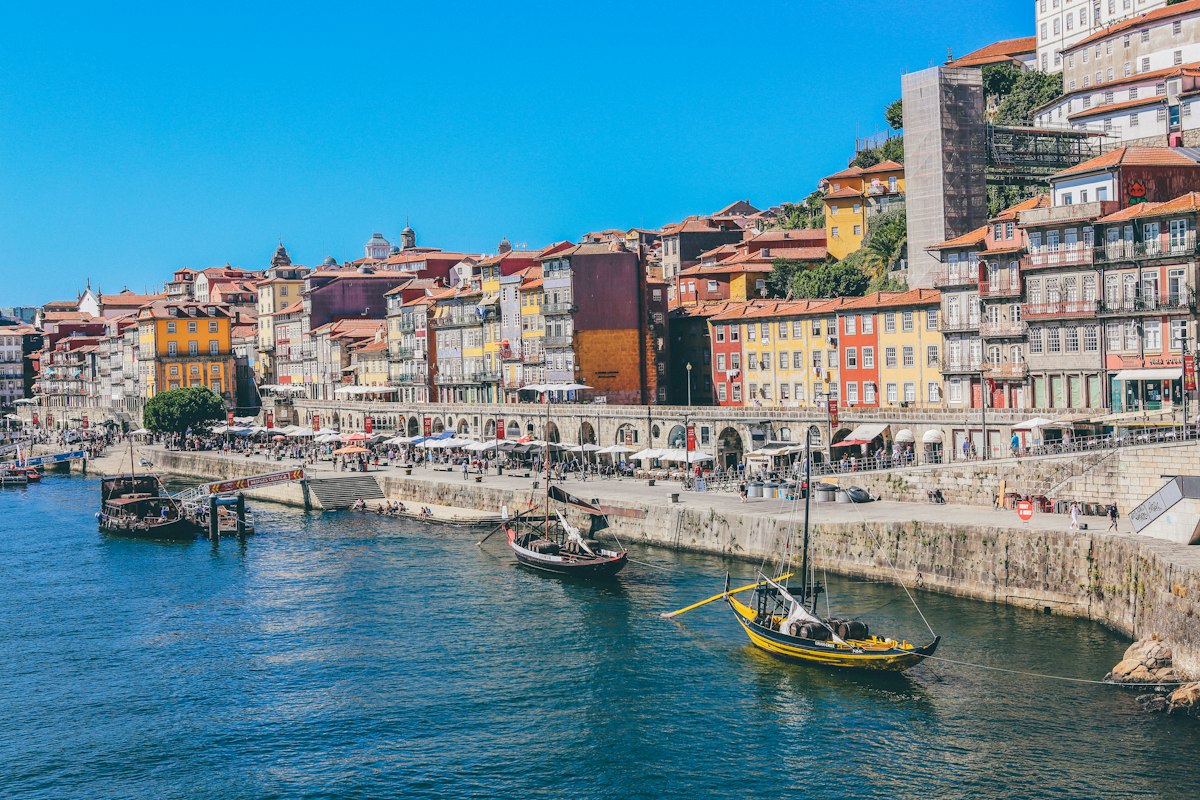
Portugal is one of the best road trip destinations in Europe. It is compact enough to cross in four hours but varied enough to sustain three weeks without repetition. The roads are good, the tolls are manageable, and the distances between genuinely different landscapes — the Atlantic cliffs of the Alentejo coast, the granite terraces of the Douro Valley, the medieval villages of the Serra da Estrela, the empty plains of the south — are short enough to change regions daily. This route covers the parts of Portugal that most visitors miss: the Alentejo heartland, the wild western coast above the Algarve, the Douro wine country in harvest season, and the high mountains that separate the Atlantic and Mediterranean weather systems. Lisbon and Porto appear only as departure and arrival points; everything between them is what makes this a worthwhile trip.
The Route
”
Fly into Lisbon. Drive southeast to Évora and the Alentejo plains. Continue south and west through Mértola to the coast at Vila Nova de Milfontes. Drive north along the Atlantic Wild Coast (Rota Vicentina) through Odeceixe, Zambujeira do Mar, and Comporta. Continue north to Porto. Drive east through the Douro Valley, staying in the vineyard estates between Régua and Pinhão. Return south via the Serra da Estrela mountains and Coimbra to Lisbon. Total driving distance: approximately 1,500-1,800 kilometres over 12-14 days. The loop avoids the A1 motorway that connects Lisbon and Porto directly in under three hours; everything interesting is on the roads between.
1. Évora, Alentejo

”
Évora is the capital of the Alentejo — a walled city on a low hill in the middle of the pale plains of southern Portugal, with a better concentration of ancient monuments in a walkable area than almost anywhere else in the country. The Roman Temple of Diana in the city centre (1st-2nd century AD, fourteen Corinthian columns still standing) survived because it was built into a medieval building that preserved the structure. The Chapel of Bones at the Church of São Francisco — constructed in the 16th century by Franciscan monks using the bones of approximately 5,000 people from the local cemetery, with a Latin inscription above the entrance that translates as ‘We bones here, await yours’ — is the most unusual interior in Portugal. The food in Évora is Alentejo cooking at its most serious: black pork from the free-range Alentejano pig raised on acorns in the montado oak forests, bread-based açorda soups, sericaia pastry with Elvas plums, and the wines of the Alentejo DOC, consistently ranked among Portugal’s best reds.
2. Monsaraz and the Alqueva Reservoir

”
Monsaraz is a medieval hilltop village inside its castle walls on the Spanish border — the kind of place that has 150 permanent residents, a single main street of whitewashed houses, a 13th-century church, and a view from the battlements across the Alqueva reservoir to Spain that justifies the detour entirely. The Alqueva is the largest artificial lake in Western Europe (250 square kilometres) created when the Guadiana River was dammed in 2002. The area around it has been designated a Starlight Reserve for dark sky quality — the Alentejo plains have virtually no light pollution in any direction, and organised stargazing experiences based around the reservoir have become a specific tourism draw. The nearby prehistoric stone circle of Cromeleque dos Almendres (one of the largest megalithic complexes in the Iberian Peninsula) is 15 kilometres from Évora and visited by a fraction of the people who go to Stonehenge for a site with comparable significance.
3. Mértola — Portugal’s Islamic Town

”
Mértola is a small town in the southern Alentejo on the Guadiana River that functions as a living archaeology project — the largest collection of Islamic-era artefacts in Portugal, a parish church that was a mosque until the Christian reconquest (the building retains its Moorish mihrab), and a castle above the river that was occupied continuously from the Iron Age through the Moorish period to the medieval Portuguese kingdom. The Islamic Heritage Museum and the several other small museums scattered through the town cover the 500 years of Moorish occupation in the south of Portugal that are underrepresented in the national narrative. Mértola is quiet, genuinely off the mainstream circuit, and a place where the accumulated layers of occupation are physically present in the streets and buildings in a way that few Portuguese towns match.
4. The Atlantic Wild Coast (Rota Vicentina)

”
The coast north of the western Algarve — from Sagres to Comporta, approximately 400 kilometres of Atlantic-facing cliffs, dunes, and fishing villages — is the last undeveloped coastline in southern Europe. The Vicentina Natural Park protects the majority of it from the resort development that transformed the eastern Algarve. By road, the N120 and coastal secondary roads pass through villages like Odeceixe (where a river meets the beach at a dramatic cliff-flanked valley), Zambujeira do Mar (a village accessed via a cliff path down to an enclosed beach), and Vila Nova de Milfontes (the largest town on the coast, with a river estuary, an old fort, and a functioning fishing harbour). The beaches here are large, exposed to Atlantic swell, and often empty on weekday mornings outside August. The water is cold. The fishing restaurants in the villages serve the catch from the boats that leave the harbour at 4am; eat the clams, the grilled sea bass, the percebes (barnacles from the cliff rocks) wherever you see them on a menu.
5. Comporta and the Tróia Peninsula

”
Comporta is a village in the rice paddy lowlands south of the Sado estuary — for years the quiet retreat of Lisbon’s artistic and intellectual community, now increasingly discovered but still without the resort infrastructure of the Algarve. The beach at Comporta stretches uninterrupted for kilometres of pale sand backed by maritime pine; the waves are Atlantic and the water is cold. The Tróia Peninsula opposite, accessible by ferry from Setúbal, is a sand spit with a Roman fishing village (Cetóbriga) visible in ruins from the dunes — fish salting factories, a temple, a cemetery — from the 1st to 4th centuries AD, abandoned when a tsunami destroyed the settlement. The dolphin population in the Sado estuary (bottlenose dolphins, a resident group of approximately 30) is observed by boat tour from Setúbal.
6. Douro Valley

”
The Douro Valley between Peso da Régua and Pinhão is the wine landscape that defines the region — terraced schist slopes descending to the river, the terraces too steep for mechanisation and still worked by hand, the quintas (wine estates) producing Port and Douro DOC table wines from Touriga Nacional, Touriga Franca, and Tinta Roriz grapes. The N222 along the south bank of the Douro between Régua and Pinhão has been named by multiple international publications as the most beautiful road in Europe; the designation is not inaccurate. Book two nights in a quinta guesthouse (Quinta do Crasto, Quinta de la Rosa, Quinta do Vale Meão, and others offer accommodation): the experience of walking the vineyard terraces before breakfast, eating dinner from the estate kitchen, and tasting the wine with the winemaker in the cellar is the Douro done correctly. A Douro River cruise departing from Porto or Régua shows the valley from the water — the perspective the road cannot provide, through the valley’s narrowest section where the terraces rise almost vertically above both banks.
7. Serra da Estrela

”
The Serra da Estrela is Portugal’s highest mountain range — the Torre peak at 1,993 metres, the roof of mainland Portugal. The plateau above the treeline is moorland and granite boulders, criss-crossed by the Zêzere River in its glacially-formed valley below. The glacial landscape — the smooth, U-shaped Zêzere valley, the Covão d’Ametade lakes, the polished granite surfaces — is immediately recognisable as glacial to anyone who has seen the Alps or the Pyrenees, and unexpected in a country with a Mediterranean coastline three hours away. The village of Manteigas in the valley is the base for hiking the glacial valley and the section of the ancient Roman Geira road that crosses the serra. The Serra da Estrela cheese — DOP-protected, made only in this region from raw ewe’s milk using thistle flower as the coagulant, producing a soft, slightly bitter, intensely flavoured wheel — is one of the great European cheeses. It is not available in supermarkets anywhere else at the quality sold at the village markets here.
8. Coimbra
”
Coimbra is the university city halfway between Lisbon and Porto — one of the oldest universities in continuous operation in the world (founded 1290), the Joanina Library (18th-century Baroque interior with three floors of gilded bookshelves, 300,000 books, and a colony of bats that protect the manuscripts by eating the insects at night), and the Fado de Coimbra tradition — a more formal, older version of Fado than Lisbon’s, performed by male students in academic cloaks and played on different guitar tunings. The Alta city above the university is one of the most visually coherent historic urban areas in Portugal. Coimbra is often skipped by travellers choosing between Lisbon and Porto; it is more interesting than either for a half-day and warrants a full day and one night to appreciate what makes it different from both.
Practical Information
”
Rent the car in Lisbon and return it in Lisbon; one-way rental fees to Porto are available but add cost. Portugal’s toll roads use an electronic system (Via Verde); many rental cars include a transponder that charges tolls automatically — confirm whether the rental includes it and whether there is a daily equipment fee. If driving a rental car without a transponder, some toll plazas have manual lanes with coin payment; others are electronic-only and require the transponder. The Alentejo and Douro Valley are best in spring (April-May, wildflowers, mild temperatures) and autumn (September-October, Douro harvest begins late September). The Atlantic Wild Coast is windier and cleaner in spring and early autumn; August sees the most visitors and the most consistent sun. Serra da Estrela has snow from December through March; the mountain roads above 1,500 metres may require snow chains. Book Douro Valley quinta accommodation six to eight weeks in advance for harvest season (September-October); it is the most in-demand accommodation in Portugal outside Lisbon and Porto.
Route, budget and verification notes
Last editorial review: 1 August 2026. Recheck time-sensitive details shortly before travel.
Build the route
- The Route
- 1. Évora, Alentejo
- 2. Monsaraz and the Alqueva Reservoir
- 3. Mértola — Portugal’s Islamic Town
Use these sections as planning anchors rather than a fixed schedule. Confirm door-to-door transfer times, opening days and reservation requirements, then add recovery time after long journeys.
Budget before booking
Price the trip in four separate groups: accommodation, transport, food and paid activities. Add local transfers, baggage fees, taxes, insurance and a contingency amount. Exact prices vary by season and booking date, so this guide does not invent a single daily figure that may already be outdated.
Sources to verify
- Visit Portugal for official or primary travel information.
- IATA Travel Centre for passport, visa and health-document checks.
