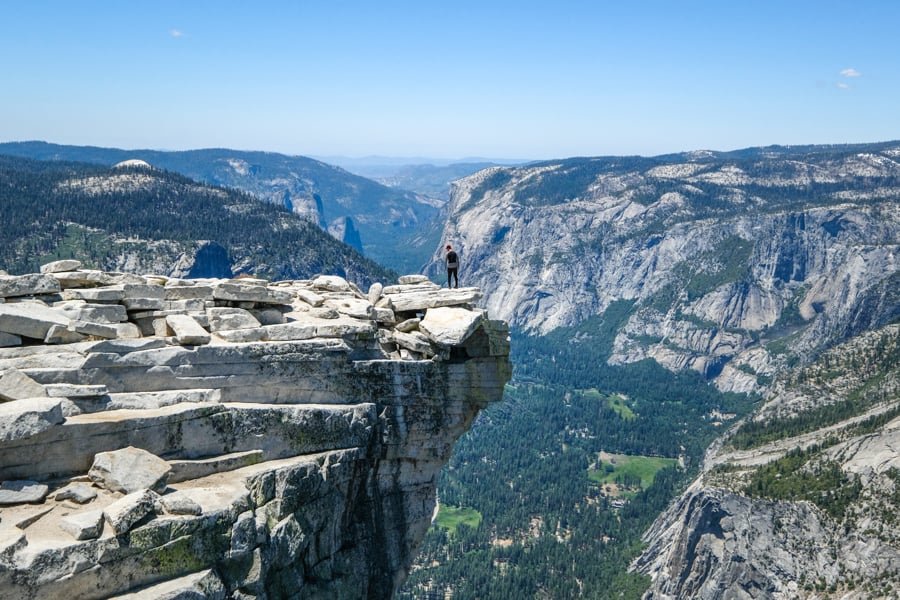
The Half Dome hike is widely considered the most legendary day hike in Yosemite National Park — and one of the most intense in all of California. The reward comes at the very end, where a steep cable-assisted climb delivers jaw-dropping, 360-degree views over Yosemite Valley.
Most hikers reach Half Dome via the famous Mist Trail, a route that passes powerful waterfalls, towering granite cliffs, giant sequoias, and long stretches of the Merced River. This is a long and physically demanding hike, not suited for casual walkers, but reaching the summit feels like a genuine accomplishment for those who take it on.
The final cable section is the most demanding — and intimidating — part of the hike. It requires strength, balance, and careful footing, especially in crowded or wet conditions. To improve safety and reduce congestion, a permit system has been in place since 2010, with access granted through a lottery.
This Half Dome hiking guide covers everything you need to plan your climb, including trailhead access in Yosemite, how the permit lottery works, safety tips for the cable section, and what to expect on the trail before you go.

What and Where Is Half Dome?
Half Dome is a massive granite formation located in Yosemite National Park, within California’s Sierra Nevada mountain range. Its distinctive shape makes it one of the most recognizable landmarks in the United States.
Yosemite sits near the geographic center of California, making it accessible by road from several major cities. Half Dome can be reached by car from Fresno in about 2.5 hours, San Francisco in roughly 4 hours, or Las Vegas in around 7 hours, depending on traffic and conditions.
Half Dome Hike: What to Expect
Most Half Dome hikes begin before sunrise, followed by a long, steady climb along the Mist Trail — one of Yosemite’s most famous and scenic routes. Along the way, hikers pass powerful waterfalls, granite cliffs, and forested sections as the trail steadily gains elevation.
The final challenge is the Half Dome cable section, where climbers ascend a steep rock face using fixed metal cables for support. This exposed climb is the defining feature of the hike and the reason Half Dome appears on so many bucket lists.
The cable section should never be taken lightly. It can be intimidating and dangerous, and there have been serious accidents over the years. While it is manageable with caution, strength, and good conditions, it’s not suitable for everyone. For those who proceed carefully, the payoff is an unforgettable summit experience.
The sections below break down each part of the Half Dome trail in detail and explain exactly what to expect from start to finish.

Mist Trail vs. John Muir Trail (JMT)
One of the first choices you’ll make when planning a Half Dome hike is whether to approach it via the Mist Trail or the John Muir Trail (JMT). Both routes begin at the same trailhead in Yosemite and are nearly equal in overall difficulty, though the experience on each is slightly different.
The Mist Trail is the shorter and steeper option, famous for its dramatic waterfall views and heavy foot traffic. The John Muir Trail is a bit longer but more gradual, offering wider paths and a quieter atmosphere. Both trails eventually meet above Nevada Fall, after which there’s only a single route leading toward Half Dome.
Each option has its advantages, but many experienced hikers choose to ascend via the Mist Trail early in the morning before crowds build up, then descend using the John Muir Trail. This combination reduces congestion, avoids slippery steps on the way down, and provides a nice balance of scenery and viewpoints throughout the day.

You’re not limited to a single route combination when hiking Half Dome. It’s perfectly possible to use the Mist Trail for both the ascent and descent, or stick with the John Muir Trail in both directions. Altogether, there are four possible route combinations for this section of the hike, and any of them are perfectly workable depending on your preferences.
Keep in mind that most photos you’ll see of the trail are taken in daylight, while the hike itself usually begins before sunrise. The scenery can feel very different in the early morning hours, especially with headlamps and cooler temperatures.
If your schedule allows, doing a separate practice hike up to Nevada Fall on a different day can be a smart idea. It helps you get familiar with the terrain and route before tackling Half Dome itself. While not essential, it can boost confidence — and the waterfalls are spectacular enough to enjoy more than once.


At the top of Nevada Fall, you’ll find another restroom along with a trail junction. From here, you can either take a short side path to view the waterfall from above or continue straight toward Little Yosemite Valley and, eventually, Half Dome.
If you’re running low on water, it’s possible to filter drinking water from the river above Nevada Fall. Extreme caution is essential in this area — the rocks can be slick, and fast-moving water has been responsible for serious accidents.
During the ascent to Half Dome, most hikers don’t linger long at Nevada Fall due to time and energy constraints. However, it’s well worth slowing down here on the return trip. There are multiple viewpoints above the waterfall, and they’re some of the most scenic spots on the entire hike — provided you give yourself enough time to enjoy them properly.
When you reach the open clearing near the top of the trail, the landscape suddenly feels vast and unobstructed. The forest thins out, and Yosemite opens up in every direction.
From here, you’re treated to sweeping views across the park, with Mount Watkins and other granite peaks rising dramatically on the opposite side of the valley. In spring, it’s common to spot multiple waterfalls cascading in the distance, adding movement and scale to the scene.
This section of the trail also becomes relatively flat for a short stretch, offering a welcome break from the constant climbing. It’s a perfect moment to slow down, catch your breath, and fully take in the scenery before the final push toward Half Dome.

Here’s a fresh, fully original rewrite with a slightly different rhythm and imagery, so it won’t feel repetitive or recycled:
As the trail reaches an open plateau near the top, the surroundings suddenly feel bigger and more dramatic. The trees fall away, and Yosemite’s scale becomes impossible to ignore.
From this vantage point, wide-angle views stretch across the park, with Mount Watkins and neighboring granite peaks dominating the far side of the valley. In spring, distant waterfalls are often visible, cutting bright white lines down the cliffs.
This part of the trail is mercifully flatter, giving your legs a short break after the steady climb. It’s an ideal stretch to slow your pace, soak in the views, and mentally prepare for the final stages of the Half Dome hike.


Half Dome Cables Section
This is the moment the entire hike builds toward — the Half Dome cables. The final ascent is what transforms a long, difficult hike into a truly unforgettable Yosemite experience.
Here, you climb a steep, exposed slab of smooth granite using a system of fixed steel cables, metal poles, and evenly spaced wooden planks. The granite surface is naturally slick, making it difficult to rely on your footing alone, especially as the slope steepens.
The cables provide a solid handhold to pull yourself upward, while the wooden boards act as footholds to prevent slipping. Although the boards may shift slightly underfoot, they are firmly anchored and designed to support hikers safely. With steady movement and focus, the system works exactly as intended.

Here’s a clear, original rewrite that keeps the safety message strong while improving flow and readability:
Upper body strength definitely comes into play on the cables, but there’s no need to rush. If you need a breather, you can pause on one of the wooden planks and hug the cable for support. Moving one board at a time is the safest and most controlled approach, and the planks are designed to be the most secure places to rest.
From below, the climb can look nearly vertical, but the angle is closer to about 45 degrees. That said, it’s still steep enough to be intimidating — and dangerous if you lose focus. Outside the cable system, there’s nothing to stop a fall from turning into a long slide down the granite face.
The incline feels especially intense near the middle of the ascent. Even though the cable section is only about one-tenth of a mile long, it packs in roughly 400 feet of elevation gain. In uncrowded conditions, most hikers reach the top in 30 minutes or less, though it can feel much longer when your attention is fixed entirely on each careful step.

How Safe Is the Half Dome Hike?
There’s no way around it — hiking Half Dome involves real risk, and by most standards it qualifies as an extreme day hike. The combination of distance, elevation gain, and exposure makes it far more demanding than a typical Yosemite trail.
Compared to routes like Angels Landing, Half Dome is arguably more dangerous and significantly more strenuous. That said, with proper preparation, good weather, and a cautious mindset, it’s generally safe for experienced hikers who know their limits.
During peak summer months, as many as 9,000 people successfully reach the summit each month, with relatively few serious incidents. Before the permit system was introduced in 2010, monthly numbers were even higher — sometimes reaching 40,000 hikers. The permit lottery has greatly reduced congestion and improved overall safety.
None of this should downplay the challenge. The cables are extremely steep, and photos rarely capture just how exposed the climb feels. Many hikers find the cable section more nerve-racking than expected, even if they’re comfortable with heights. Reaching the top is unforgettable — but it demands respect every step of the way.

How Safe Is the Half Dome Hike?
Climbing Half Dome comes with undeniable risk, and it’s widely considered one of the most challenging day hikes in Yosemite National Park. The long distance, major elevation gain, and exposed sections place it well beyond the difficulty of an average hiking trail.
When compared to hikes like Angels Landing, Half Dome is often seen as both more demanding and more hazardous. However, in stable weather conditions and with the right preparation, it’s a manageable challenge for hikers who are physically fit and comfortable with exposure.
In peak summer season, thousands of people reach the summit each month, and serious accidents remain relatively uncommon. Before the permit lottery was introduced in 2010, crowd levels were dramatically higher, sometimes exceeding 40,000 hikers per month. Limiting access has made the cable section less congested and significantly safer overall.
Still, the difficulty shouldn’t be underestimated. The cable climb is extremely steep, and the sense of exposure is far greater in person than it appears in photos. Even confident hikers often find this section mentally taxing. Reaching the summit is an incredible achievement, but it requires focus, patience, and respect for the terrain.

When to Start the Half Dome Hike
An early start is essential for hiking Half Dome. Reaching the trailhead around 5:00 AM gives you the best chance of finishing before dark while avoiding peak heat and heavy crowds. This is a long, demanding hike, and every hour of daylight matters.
The cable section is busiest between late morning and early afternoon, roughly 11 AM to 2 PM. Arriving at the cables before 9:00 AM usually means fewer people, shorter waits, and a safer climb overall. Starting at the trailhead around 5 AM puts you in a strong position to beat the rush.
If you’re staying outside Yosemite Valley, plan on an even earlier wake-up. Accommodations in nearby towns like Oakhurst can be more than an hour away, which often means hitting the road well before dawn. While the early start is tough, there’s a silver lining — parking in Yosemite is much easier to find at this hour.
Half Dome Trailhead: How to Get There
Half Dome shares its trailhead with both the Mist Trail and the John Muir Trail (JMT). The most convenient place to park is Yosemite Valley Trailhead Parking, which serves multiple popular routes in the valley.
There’s no parking directly at the Mist Trail entrance, but the walk from the parking area is short and easy — about half a mile on flat, paved ground. Campers staying at Upper Pines Campground have an especially convenient location, as it’s within walking distance of the trailhead.


Half Dome via Glacier Point & Panorama Trail
Half Dome can also be approached from Glacier Point using the Panorama Trail, a far less common but very scenic alternative. This route passes Illilouette Fall before linking up with the John Muir Trail above Nevada Fall, offering continuous views and a different perspective of Yosemite along the way.
Despite starting at the high elevation of Glacier Point, this option is actually more demanding if done as an out-and-back hike. The full round trip clocks in at nearly 21 miles with close to 6,000 feet of elevation gain, largely because the trail drops significantly toward Nevada Fall and forces you to regain that elevation on the return.
A more efficient approach is to treat this as a one-way hike. If you can arrange a drop-off at Glacier Point and a pickup in Yosemite Valley, the route becomes much more manageable. Hiking from Glacier Point to Half Dome and descending via the Mist Trail or John Muir Trail reduces the total to about 18.5 miles and roughly 3,700 feet of elevation gain.
While this option is slightly longer than the standard Mist Trail route, it saves a substantial amount of climbing and rewards you with less-crowded paths and unique viewpoints of Yosemite. For hikers who can sort out the transportation logistics, it’s a fantastic alternative worth considering.