South Iceland Waterfalls
1. Seljalandsfoss Waterfall
Seljalandsfoss is often the very first waterfall travelers encounter when driving south from Reykjavik along Iceland’s famous Ring Road, and it makes an unforgettable introduction to the country’s dramatic landscapes. Thanks to its elegant drop and easy access, it’s also one of the most photographed waterfalls in Iceland.
During the summer months, the area around Seljalandsfoss comes alive with green meadows, wildflowers, and frequent rainbows dancing through the mist. The waterfall plunges about 60 meters (200 feet) over a cliff, and what truly sets it apart is the footpath that allows you to walk completely behind the cascading water for a unique and immersive viewpoint.
Expect plenty of spray near the falls, especially when walking behind it. Waterproof clothing is highly recommended, and it’s wise to protect cameras and phones from the constant mist.
Located just 120 kilometers (75 miles) from Reykjavik, Seljalandsfoss is an easy and popular day trip from the capital. It’s often combined with nearby highlights such as Skógafoss and other scenic stops along Iceland’s south coast, making it a perfect addition to any South Iceland itinerary.


2. Gljúfrabúi Waterfall
While visiting Seljalandsfoss, make sure you don’t skip nearby Gljúfrabúi, one of South Iceland’s most magical hidden waterfalls. This lesser-known gem is located just a short 5-minute walk from Seljalandsfoss, yet it feels like a completely different world.
Gljúfrabúi drops approximately 40 meters (130 feet) and is partially concealed inside a narrow canyon cave, which gives the waterfall a mysterious, almost secretive atmosphere. You can experience it in two different ways: either walk carefully through the cave’s front opening for an up-close view, or climb the small hill beside it and look down through an opening in the cave’s ceiling.
Access to the upper viewpoint is straightforward thanks to a small ladder on the hillside near the entrance, and it’s easy to spot once you’re there.
Inside the cave, the spray is intense and the air is thick with mist. Waterproof jackets, pants, and protected camera gear are strongly recommended unless you’re prepared to get soaked. Despite the moisture, stepping inside Gljúfrabúi is a memorable experience and well worth the effort for adventurous travelers exploring Iceland’s south coast.

3. Skógafoss Waterfall
Skógafoss is the waterfall that first put Iceland on the map for me — genuinely. One photo of this towering giant was enough to spark an entire trip.
At nearly impossible-to-mess-up levels of photogenic, Skógafoss delivers drama from every angle. A powerful wall of water plunges straight down from a height of 60 meters (200 feet), crashing onto black volcanic sand below. On either side, lush green cliffs frame the falls so perfectly they look designed by a fantasy film set decorator.
Thanks to the constant mist, rainbows are common on sunny days, adding another layer of magic to an already iconic scene. You can stand right at the base of the waterfall for a full sensory experience — expect thunderous sound, wind, and plenty of spray — or climb the staircase beside the falls for a panoramic view from above.
Located directly along Iceland’s Ring Road, Skógafoss is one of the easiest waterfalls to access on the South Coast, making it a must-stop for road trippers and first-time visitors alike. Iconic, powerful, and endlessly photogenic, Skógafoss lives up to every bit of its legendary reputation.

Skógafoss (pronounced “skoa-foss”) is impressive not only for its beauty, but also for its sheer scale. Standing around 60 meters (200 feet) tall and 25 meters (82 feet) wide, it ranks among the largest and most powerful waterfalls in Iceland.
The immense force of the falling water creates a constant cloud of mist, and on sunny days this often results in a stunning full rainbow stretching across the base of the falls. It’s one of the best places in Iceland to photograph rainbows, but be warned: if you walk closer than 30 meters, you’ll get soaked very quickly. Waterproof jackets and camera protection are highly recommended.
Adding to its mystique, Skógafoss is wrapped in local legend. According to Icelandic folklore, one of the island’s first Viking settlers is said to have hidden a treasure chest filled with gold behind the waterfall. While the treasure has never been found, the story only adds to the magical atmosphere of this iconic Icelandic landmark.


4. Kvernufoss Waterfall
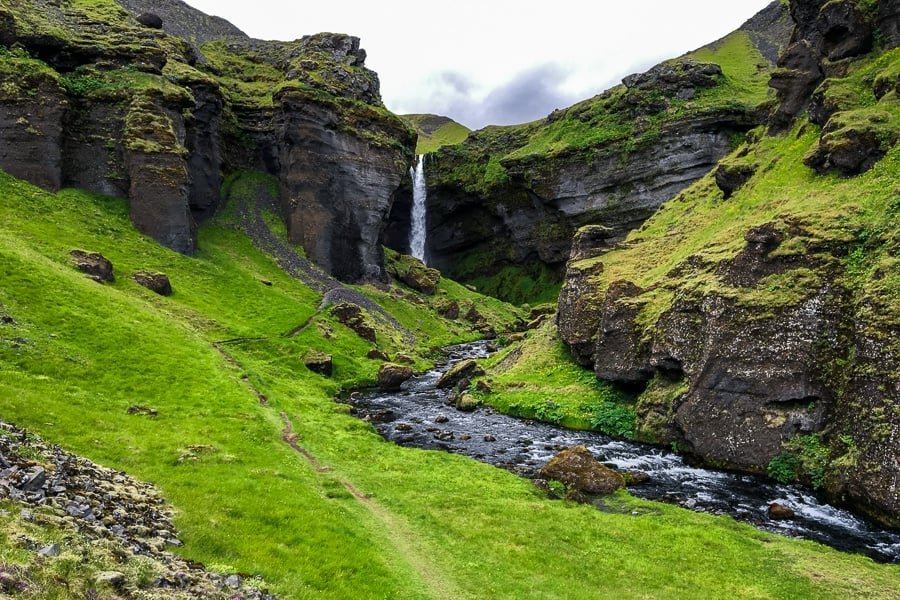
Kvernufoss is a hidden gem in South Iceland, located just a short distance from the famous Skógafoss. Although it’s only about 30 meters (100 feet) tall, this lesser-known waterfall easily ranks among the most beautiful waterfalls in Iceland thanks to its peaceful setting and dramatic scenery.
The walk from Skógar to Kvernufoss is part of the experience. The short, easy hike follows a lush river through a narrow green canyon, with moss-covered cliffs rising on both sides. It genuinely feels like a scene straight out of The Lord of the Rings. Even before reaching the waterfall, the landscape alone makes the hike worthwhile.
Unlike its crowded neighbor Skógafoss, Kvernufoss remains relatively quiet, making it a perfect spot for photography, nature lovers, and travelers looking to escape the crowds while exploring South Iceland’s waterfalls.

5. Svartifoss Waterfall
Svartifoss is easily one of the most unique waterfalls in Iceland, famous for the dramatic black basalt columns that frame the cascade. The name Svartifoss literally means “Black Falls,” a nod to the dark volcanic rock formations that resemble giant organ pipes rising from the canyon walls.
Reaching Svartifoss requires a short hike, but it’s very manageable for most travelers. The trail is well-marked and takes about 30 to 45 minutes one way, covering roughly 1.5 kilometers (1 mile). While there is some elevation gain—around 120 meters—the hike is considered easy and rewarding, with scenic views along the way.
In photos, Svartifoss can appear smaller than it really is, but the waterfall stands at an impressive 20 meters (65 feet) tall. Its true scale becomes clear once you’re standing nearby, especially when people are visible for comparison. The striking contrast between white water and black basalt makes Svartifoss a must-see stop when exploring South Iceland’s waterfalls.

6. Hengifoss Waterfall
Hengifoss is one of the most extraordinary waterfalls in Iceland, and that’s saying something in a country overflowing with epic cascades. It faces stiff competition from giants like Dynjandi and Háifoss, but Hengifoss stands apart thanks to its truly alien appearance.
The waterfall plunges 130 meters (420 feet) down a towering cliff, making it the second tallest waterfall in Iceland. What really steals the show, though, are the striking red clay layers sandwiched between dark basalt rock. These horizontal red stripes look so surreal they make the landscape feel more like Mars than Earth.
The contrast between the fiery red sediment, black volcanic stone, and white rushing water is unforgettable. Hengifoss isn’t just tall—it’s dramatic, strange, and wildly photogenic, making it a must-see for travelers looking to experience Iceland’s most unique natural scenery.

7. Litlanesfoss Waterfall
Litlanesfoss is a striking waterfall you’ll pass on the hike to Hengifoss, and it’s far more than just a warm-up act. Like Svartifoss, this waterfall is framed by dramatic basalt column formations that look almost man-made, as if the cliffs were carefully carved rather than shaped by volcanic forces.
At around 30 meters (100 feet) tall, Litlanesfoss isn’t among Iceland’s largest waterfalls, but it easily makes up for that in character. The geometric rock walls give it a bold, otherworldly look that feels distinctly Icelandic.
The best part? You don’t need to go out of your way to see it. If you’re already hiking to Hengifoss, Litlanesfoss comes as a beautiful bonus, turning a single trail into a two-waterfall payoff. Two wildly different, unforgettable waterfalls on one short hike—hard to beat in Iceland.

8. Gufufoss Waterfall
Gufufoss is one of those Icelandic waterfalls that feels like a secret you weren’t supposed to find. Often compared to Skógafoss, it has a very similar look—a wide curtain of water crashing down into a rocky stream—but without the crowds, noise, or tour buses.
Just like its famous twin, you can walk right up to the base of the falls or take a short hike to reach the top for a different perspective. The power of the water, the surrounding cliffs, and the constant mist give it that classic Iceland waterfall atmosphere, only in complete peace and quiet.
The biggest difference is popularity. Skógafoss can have hundreds of visitors at any given moment, while Gufufoss remains remarkably untouched. When I visited, there wasn’t another soul in sight. If you’re looking for a dramatic waterfall experience without the crowds, Gufufoss is an easy win and a perfect final stop on an Iceland waterfall road trip.

9. Dettifoss Waterfall
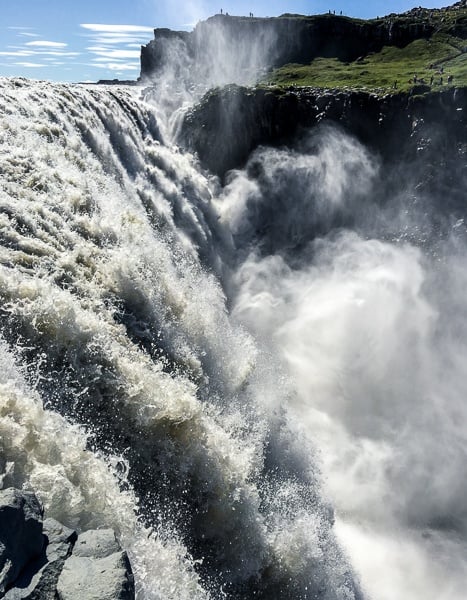
Dettifoss is an absolute beast. Known as the most powerful waterfall in Europe, it’s fed by a massive glacial river, and the raw force of the water is almost hard to comprehend in person. The ground trembles, the air fills with mist, and the roar is thunderous—it feels less like a waterfall and more like the Earth tearing itself open.
Standing near Dettifoss really puts things into perspective. The volume of water surging through the canyon is pure chaos, and it’s mesmerizing to watch. Keep a safe distance, though—the spray makes the rocks slippery, and the drop is unforgiving. Curiosity is understandable here, but Dettifoss demands respect.
The waterfall is located about 170 kilometers (105 miles) east of Akureyri and requires roughly a 40-minute detour from Iceland’s Ring Road. Despite its remote feel, it’s surprisingly easy to reach and well worth the effort if you’re exploring northern or eastern Iceland. If Iceland had a definition of “raw power,” Dettifoss would be it.
10. Goðafoss Waterfall
Goðafoss is one of Iceland’s most historically significant waterfalls. According to legend, when Iceland officially converted from paganism to Christianity around the year 1000, a local chieftain symbolically threw the old Norse idols into these waters. This moment gave the waterfall its name—Goðafoss, meaning “Waterfall of the Gods.”
History aside, Goðafoss is also visually striking. Rather than a single drop, it’s a wide series of cascades forming a graceful horseshoe shape. The water has an intense blue-green color that almost looks unreal, especially on sunny days. In scale and shape, it’s often compared to a smaller, more elegant version of Niagara Falls—powerful, yet beautifully balanced.
Goðafoss is located about 50 kilometers (30 miles) east of Akureyri in northern Iceland and sits right next to the Ring Road. Thanks to its easy access and dramatic scenery, it’s one of those classic Iceland stops that’s absolutely worth pulling over for, even on a tight itinerary.

11. Dynjandi Waterfall
Dynjandi is one of Iceland’s most spectacular waterfalls, and it feels less like a single cascade and more like an entire system of waterfalls flowing together. From a distance, it resembles a massive white veil spilling down the mountainside, widening as it descends. The total height is around 100 meters, and the sound is thunderous—you can hear the roar of the water from the parking area nearly a kilometer away.
Located in the remote Westfjords, Dynjandi is far off the usual tourist trail. It sits about 360 kilometers (220 miles) north of Reykjavik, and reaching it involves driving through dramatic fjord landscapes with steep, winding roads. Despite the intimidating scenery, the waterfall is still accessible with a standard 2WD rental car in good conditions.
The journey is part of the experience here. If you’re willing to venture into the Westfjords, Dynjandi rewards the effort with one of the most unforgettable waterfall views in all of Iceland—wild, powerful, and completely unspoiled.

12. Kirkjufellsfoss Waterfall
Kirkjufellsfoss is one of the most iconic waterfalls in West Iceland, located on the Snæfellsnes Peninsula. If there’s a single spot that perfectly matches the postcard image of Iceland, this might be it.
The name means “church mountain falls,” inspired by the sharp, cone-shaped peak rising behind the waterfall. Some say it resembles a church steeple, though it arguably looks more like a wizard’s hat—an impression that fits nicely, since the whole scene feels lifted straight out of a fantasy film. It’s no surprise this location has become one of the most photographed landscapes in Iceland.
The waterfall itself is relatively small, but the composition is what makes it special: multiple cascading streams in the foreground, Kirkjufell mountain standing dramatically behind them, and wide open skies that change mood with the weather.
Kirkjufellsfoss is about a 2.5-hour drive from Reykjavik and very easy to access. From the parking area, it’s only a five-minute walk to the falls. If you’re exploring the Snæfellsnes Peninsula—which is highly recommended—this stop is an absolute must.

13. Brúarfoss Waterfall
Brúarfoss easily earns the title of the bluest waterfall in Iceland—and arguably one of the bluest waterfalls in the world. The color almost doesn’t look real. Intense turquoise glacial water rushes through dark volcanic rock, creating a striking contrast that feels more like digital art than nature.
The waterfall itself isn’t very tall, but that’s beside the point. What makes Brúarfoss special is how the river squeezes into a narrow rocky crevice, accelerating the flow and intensifying the color. On a sunny day, the electric blue hues are absolutely jaw-dropping and unlike anything else in Iceland.
Brúarfoss was temporarily closed in the past due to a land dispute, but it has since reopened and is once again accessible to visitors—great news, because this is a must-see stop on the Golden Circle route.
The waterfall is located about 95 kilometers (60 miles) from Reykjavik, with a drive time of roughly 1.5 hours. From the parking area, it’s a short and easy walk to the bridge overlooking the falls, making Brúarfoss one of the most rewarding waterfalls in Iceland for minimal effort.

14. Gullfoss Waterfall
Gullfoss is one of Iceland’s most iconic waterfalls and a major highlight of the famous Golden Circle route. Powerful, dramatic, and impossible to ignore, this massive two-tier waterfall crashes into a deep canyon, creating nonstop mist, thunderous sound, and unforgettable views from multiple vantage points.
The name Gullfoss means “Golden Falls” in Icelandic, inspired either by the golden glow the water takes on in sunlight or by old legends of hidden treasure. The waterfall is fed by meltwater from the Lángjökull glacier, one of Iceland’s largest ice caps, which explains its immense force year-round.
What makes Gullfoss especially memorable is how close you can get. Well-maintained paths lead to viewpoints both above and right beside the falls, allowing you to truly feel the raw power of Icelandic nature. On sunny days, rainbows often appear in the mist, adding to the spectacle.
Because of its easy access and sheer scale, Gullfoss is often crowded—but it absolutely lives up to the hype. If there’s one waterfall that defines Iceland for first-time visitors, this is it.

15. Haifoss Waterfall
Haifoss is one of Iceland’s most spectacular waterfalls—and also one of the most underrated. Tucked away in a remote highland area, it takes a bit of effort to reach, but the reward is absolutely worth it.
Plunging an impressive 120 meters (400 feet) into a dramatic canyon, Haifoss ranks as the third tallest waterfall in Iceland. The scale is hard to process at first glance. Standing at the viewpoint, the landscape feels vast, wild, and almost untouched.
What makes Haifoss even more special is that it doesn’t stand alone. Right next to it, a second massive waterfall spills into the same canyon, doubling the visual impact. The canyon itself is enormous, carved deep into the earth, and the layered rock formations add to the sense of raw power and age.
The panoramic views from above are nothing short of jaw-dropping. This is the kind of place where you’ll want to linger, take it all in, and wonder how somewhere so incredible can still feel like a hidden gem in Iceland.